Freezer rooms for restaurants and central kitchens become necessary when frozen stock outgrows a row of chest and upright freezers or when one kitchen starts supplying several branches. The room holds food at -18 °C or colder. It does not freeze hot food: cooked batches go through a blast chiller or blast freezer first. This guide covers stock planning, layout, defrost timing and staff safety.
Signs that chest and upright freezers are no longer enough
- A full frozen delivery no longer fits, so cartons wait on the floor while staff rearrange.
- Stock at the bottom of a chest freezer gets forgotten and first in, first out fails.
- Lids and doors open all day and frost builds up inside.
- Each unit has its own compressor that heats the storeroom.
- Nobody has one temperature record for all frozen stock.
A freezer room is not a chiller with a lower setpoint
The construction changes with the temperature:
- Panels: typically 120 to 150 mm thick, against 80 to 100 mm for chilled rooms. In a hot climate choose the upper end.
- Floor: insulated. Large freezers built on the ground also need frost heave protection under the slab.
- Door: a heated frame, often a heated threshold and a safety release inside.
- Pressure relief valve: heated, to balance the pressure when the air inside cools and shrinks.
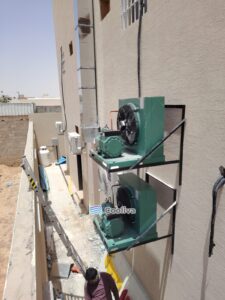
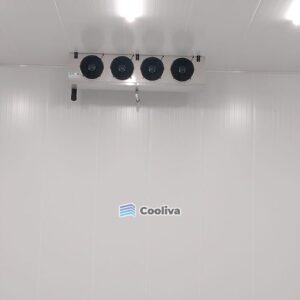
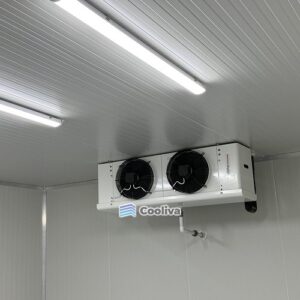
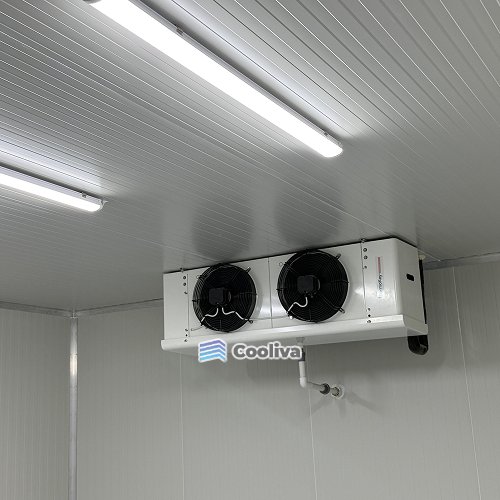
- Evaporator: wider fin spacing, electric or hot gas defrost several times a day and a heated drain line.
This is why a chiller cannot become a freezer by lowering the setpoint. For the full comparison see cold room vs freezer room and our guide to freezer room design in Saudi Arabia.
Planning frozen stock for a central kitchen with branches
A central kitchen freezer feeds other kitchens, so plan it like a small distribution store. Start with three lists:
- Bought-in frozen goods: chicken, seafood, fries or vegetables. How many cartons per delivery and how many deliveries per week?
- Your own production: sauces, marinated portions, par-cooked items and dough. How many kilograms per batch and how many batches per day?
- Dispatch: how many branches, how often each one receives and how many days of buffer stock you hold.
Then decide how the stock sits in the room. Hand-picked cartons go on shelving, each product in a fixed position. Bulk goods stay on pallets of 1.2 x 1.0 m or 1.2 x 0.8 m, which need a door and an aisle to match. Raw products get their own zone, away from cooked and ready-to-eat items. Every tray and carton carries a production date.
Confirm all storage temperatures with your supplier and the applicable SFDA requirements. Tell the contractor about the branches you plan to open, so the design leaves room to grow.
Layout: let the freezer open into the chiller
In a restaurant, the best place for the freezer door is often inside the chiller room. Each time the freezer door opens it takes in air at 0 to +4 °C instead of hot, humid kitchen air. The gains:
- Less frost on the evaporator and around the door frame.
- Less ice on the floor at the door.
- Lower energy use, because less heat and moisture enter.
The price is traffic: all frozen stock crosses the chiller, so keep an aisle wide enough for a trolley. A central kitchen that moves pallets uses a cooled anteroom instead, typically at +2 to +8 °C, between the freezer and the dock. For the chilled side, see cold rooms for restaurants.
Blast chill or blast freeze first, then store
Cooked food leaves the kettle at +70 °C or more. Bacteria multiply fastest between +5 °C and +60 °C, so the aim is to cross that band quickly. Two benchmarks guide the process:
- Blast chilling: from +70 °C to +3 °C at the core within 90 minutes.
- Blast freezing: to -18 °C at the core within about 240 minutes, with air at typically -30 to -40 °C.
A storage freezer cannot do this job. It is built to hold frozen product, not to freeze warm product fast. Put hot trays inside and the room temperature rises for hours, nearby frozen stock warms at the surface and steam turns into heavy frost on the evaporator. The food itself freezes slowly, large ice crystals form and the texture suffers after thawing.
Check the limits that apply to your kitchen against the applicable SFDA requirements. The working sequence:
- Portion the batch into shallow trays.
- Load the blast chiller or blast freezer straight away.
- Check the core temperature with a probe and record it.
- Cover, label and date the trays.
- Move them to the storage freezer without delay.
The weight of one batch and the time allowed decide the size of a blast freezer or blast chiller.
Defrost timing: follow the kitchen, not the factory setting
Freezer evaporators collect frost from every door opening. Electric or hot gas defrost clears it several times a day. During a defrost the coil heats up and cooling pauses, so the start times matter. An example for a central kitchen:
| Time of day | In the kitchen | For the freezer room |
|---|---|---|
| Early morning | Staff pick and load branch orders | Heavy door traffic. No defrost |
| Mid-morning | Frozen deliveries arrive | Cartons enter. No defrost |
| Midday | Cooking, few visits to the freezer | Good slot for a defrost |
| Afternoon | Blast-frozen batches move into storage | Product enters frozen, so the added load is small |
| Night | Kitchen closed, door shut | Good slot for defrost and full recovery |
Your day will differ. A restaurant open until 2 am has its quiet slot in the morning. In Ramadan the whole schedule moves toward the night, so reset the times when your opening hours change. Ask about demand defrost, which starts a cycle only when frost has built up. Heavy frost on the evaporator is a warning sign that calls for a technician. See our guide to freezer room maintenance.
Staff safety at -18 °C
- Every door needs a safety release inside. Test it regularly with the door closed.
- Ask for an alarm button inside the room that sounds in the kitchen.
- Keep insulated jackets and gloves at the door. Frozen metal trays injure bare hands.
- Keep visits short and run stock counts in pairs.
- Treat ice on the floor as a fault to fix. It usually points to warm air entering at the door.
- Nobody works inside a blast freezer while it runs.
Freezer room questions from kitchen managers
Can ice cream share the freezer room with other frozen food?
It can, but it needs a colder room. Ice cream is typically stored at -23 to -25 °C and general frozen food at -18 °C or colder. Running the whole room colder uses more energy, so a dedicated ice cream freezer is often the simpler answer. Confirm the figure with your supplier.
Does a small restaurant need a blast freezer too?
Only if you cook food and freeze it yourself. A kitchen that stores bought-in frozen goods needs a storage freezer alone. A kitchen that cooks in batches for later days needs at least a blast chiller.
What should staff do if the freezer room stops at night?
Keep the door shut. A closed, well-stocked freezer room warms slowly, but no fixed number of safe hours applies to every room. Call your service contractor and check product temperature before you decide what to keep. A high temperature alarm that reaches a phone wins you those hours.
Frozen storage for your kitchen, built by Cooliva
From its base in Riyadh, Cooliva builds cold rooms and freezer rooms for restaurants, catering companies, central kitchens and cloud kitchens. Tell us what you freeze, how many branches you supply and how your day runs. We review the site, plan the freezer room with its link to your chiller and blast equipment, then install, test and hand over. To arrange a site visit, use the contact page or call +966 59 799 1000.