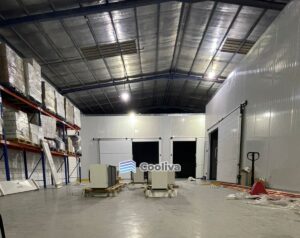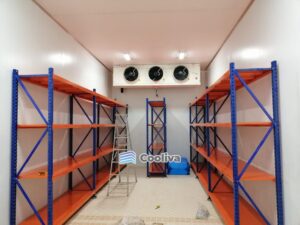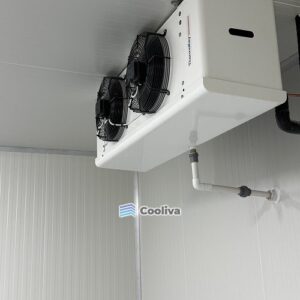

Modify your cold room when the insulated panels are sound and the problem is capacity, an ageing refrigeration unit, a worn door or missing monitoring. Replace it when the panels are wet or damaged, the floor has failed or a chiller must become a freezer. This guide to cold room upgrade and expansion gives you the checks to make first, the options and a decision table.
Assess five things before you decide
- Panels. Look for skins that bulge or separate from the foam, rust at floor level, open joints, wet patches outside and frost lines inside. Moisture that enters a panel turns to ice and ruins the insulation. Sound panels are the strongest argument for modifying.
- Refrigeration unit. Note its age, repair history and refrigerant. Many markets are phasing down R404A because of its high global warming potential. Check that the unit is rated for 60 Hz power and was selected for Saudi summer conditions.
- Capacity gap. Decide which capacity you lack. Full aisles and stock stacked against the walls mean you need space. A room that warms up after loading or on hot afternoons needs cooling capacity.
- Floor. Check for cracks, worn surfaces and standing water. Confirm that the floor suits the pallet trucks or forklifts you plan to use.
- Door. Compare the door with the traffic you have today. Hinged doors suit people and trolleys. Sliding doors suit pallets and forklifts. Check the gasket and the clear opening.
Check the power supply too. A larger unit needs spare capacity on your distribution board.
Six ways to modify an existing room
1. Replace the refrigeration unit only
This is the usual upgrade when the panels are sound and the machinery is tired. A new condensing unit selected for high ambient, commonly 46 to 50 °C design, restores capacity in summer. The evaporator and expansion valve often change with it so the parts match. Ask about a refrigerant with lower global warming potential such as R448A or R449A. Brands listed among Cooliva’s technology partners include Bitzer, Copeland and Danfoss.
2. Add an evaporator or a condensing unit
When only cooling capacity is short, a second system closes the gap. It also gives you a reserve: if one system stops, the other holds part of the load.
3. Extend the panel envelope
Sandwich panels are modular, so an installer can remove an end wall and add new panels. The new panels must match the old thickness. The installer must seal the joint between old and new against vapour. An extension adds heat load, so recheck the refrigeration capacity before you order.
4. Split the room into two temperature zones
An insulated partition with its own door turns one room into two. Each zone gets its own evaporator and controller. A freezer zone needs freezer-grade panels, an insulated floor and a heated door frame.
5. Fit a new door
Change a hinged door to a sliding door when you move from trolleys to pallets. Consider a rapid roll door for heavy traffic. Add PVC strip curtains at the same time.
6. Add monitoring
A digital controller with alarms, a data logger and remote alerts fits an existing room without changes to the envelope. See our guide to cold room temperature monitoring.
Why a chiller rarely becomes a freezer
Lowering the setpoint of a chilled room does not make it a freezer. Freezers typically hold frozen food at -18 °C or colder. Confirm the target with your supplier and the applicable SFDA requirements. At that temperature almost every part of a chilled room is wrong for the job:
- Panels. Chilled rooms typically use 80 to 100 mm panels and freezer rooms 120 to 150 mm. Thin panels at freezer temperature let in far more heat and sweat on the outside.
- Floor. Many chilled rooms have no insulated floor. A freezer needs one. A large freezer on the ground also needs frost heave protection under the slab.
- Evaporator. Freezer evaporators use wider fin spacing and electric or hot gas defrost. A chiller coil with air defrost soon blocks with ice.
- Compressor. A unit selected for chilled duty is not built to run at freezer conditions.
- Door and fittings. A freezer needs a heated door frame, a heated drain line and a heated pressure relief valve.
Conversion therefore usually means new panels, floor, refrigeration and door: a new freezer room in the old space. Read our guide to freezer room design in Saudi Arabia before you plan one.
Cold room upgrade and expansion: modify or replace?
| Situation | Modify or replace | Why |
|---|---|---|
| Panels sound, unit old or unreliable | Modify: replace the refrigeration unit | The envelope still has service life. New machinery fixes reliability. |
| Room holds temperature but is full | Modify: extend the envelope | Modular panels allow it. Recheck the cooling capacity. |
| Room has space but warms up in summer | Modify: add or replace refrigeration | The gap is in the machinery. |
| You need chilled and frozen storage | Modify: partition into two zones | It works when panels and floor suit the freezer zone. |
| Door wrong for the traffic you have | Modify: new door | A small job with a quick effect. |
| No alarms or temperature records | Modify: add monitoring | No change to the envelope. |
| A few panels damaged by impact | Modify: replace those panels | Panels are modular. |
| Panels wet, delaminated or rusted throughout | Replace | Wet insulation does not recover. New machinery on a failed envelope wastes energy. |
| Chiller must become a freezer | Replace in most cases | Panels, floor, evaporator, compressor and door all change. |
| Freezer floor lifted or badly cracked | Replace or rebuild | The cause lies under the slab. |
Ask the contractor to quote both options on the same basis. When the cost of modifying comes close to the cost of a new room, replacement gives you a longer service life. See our article on what determines cold room cost in Saudi Arabia.
Plan the downtime and temporary storage
- Pick a quiet period in your business calendar. Avoid the hottest weeks if the work opens the room to outside air.
- Run stock down before the work starts and reschedule deliveries.
- Arrange temporary storage: another room on site, a rented refrigerated container or space in a cold store.
- Phase the work. Build and commission an extension as a separate box and cut the opening in the old wall last.
- Record product temperatures during every transfer.
- Ask for commissioning after the work: a leak test, a pull-down test and a check of defrost and alarm settings.
Frequently asked questions
Can new panels be joined to panels from another manufacturer?
Often yes if the thickness matches. Joint profiles differ between manufacturers, so the installer may need a transition detail. The installer seals the junction on the warm side.
Do I have to empty the room during an upgrade?
It depends on the work. Monitoring and many door jobs need little clearing. A unit replacement needs a short shutdown. The installer can build an extension next to the running room. Partition and floor work need the area emptied.
Should I replace an R404A unit that still works?
Not for that reason alone. A leak-free unit in good condition can stay in service. Many markets are phasing down R404A, so plan the change for the day a major repair comes up.
How much extra capacity should I allow when I expand?
Size the envelope for your stock forecast for the next two or three years. Size the refrigeration from a heat load calculation. An oversized compressor starts and stops too often, which wears it out.
Talk to Cooliva before you decide
Cooliva upgrades and expands existing rooms and builds new cold rooms and freezer rooms from its base in Riyadh. The five checks above are the starting point for a site review of your chiller room or freezer room. From there we plan the work under our refurbishment and upgrade or expansion and modification service. Send photos, room dimensions and your target capacity through the contact page or call +966 59 799 1000.