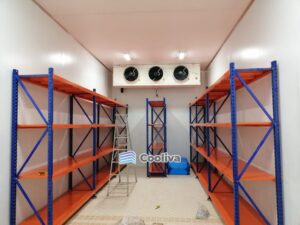
A cold room, also called a chiller room, keeps fresh products cold without freezing them, typically at 0 to +4 °C. A freezer room holds frozen products at -18 °C or colder. That gap of about 20 degrees changes the panels, the floor, the door, the evaporator and the compressor. Lowering the setpoint does not turn a cold room into a freezer room.
Cold room vs freezer room side by side
| Feature | Cold room (chiller) | Freezer room |
|---|---|---|
| Room temperature | Typically 0 to +4 °C | -18 °C or colder |
| Products | Dairy, fresh meat and poultry, fruit and vegetables, beverages, prepared food | Frozen meat, poultry and seafood, frozen vegetables, ice cream, frozen dough |
| Panel thickness | 80 to 100 mm | 120 to 150 mm |
| Floor | Insulated floor recommended. Some chillers sit on the building slab | Insulated floor required. Large freezers on the ground need frost heave protection |
| Door | Insulated door with gasket and inside safety release | Thicker door with frame heater, often a threshold heater and inside safety release |
| Defrost | Air (off-cycle) defrost above about +2 °C | Electric or hot gas defrost several times a day |
| Design running time | About 16 to 18 hours a day | About 18 to 20 hours a day |
| Energy use | Lower | Higher for the same room size |
| Relative cost | Lower | Higher: thicker panels, larger refrigeration, floor insulation and door heaters |
These are typical values. Confirm product temperatures with your supplier and the applicable SFDA requirements. Our guide to cold room temperature by product gives the range for each food group.
A note on the names
In the trade, “cold room” often means any refrigerated room. In this article it means the chiller. “Freezer room” always means frozen storage. When you ask for a quotation, state the temperature in degrees instead of the name. It removes any doubt.
What 20 degrees change
Take a Riyadh summer day with 45 °C outside. A chiller at +2 °C works against a difference of 43 degrees. A freezer at -18 °C works against 63 degrees. Heat flow through a wall rises in step with that difference, so the freezer needs thicker panels to hold the heat gain down.
The second change is ice. Below 0 °C the moisture that enters the room freezes: on the evaporator, around the door and in the drain. Much of a freezer’s extra equipment exists to manage that ice. Defrost heaters clear the evaporator. Frame heaters keep the door from freezing shut. A heater keeps the drain line open.
Why a chiller does not become a freezer at a lower setpoint
Owners often ask whether an existing chiller room will hold -18 °C once the controller is changed. It will not, for five reasons.
- Panels. Chiller panels are typically 80 to 100 mm thick. With 45 °C outside, the same wall lets in nearly 50 percent more heat at -18 °C than at +2 °C. The refrigeration system was never sized for that.
- Floor. Some chillers have a thin insulated floor or none. At freezer temperature heat enters through the slab all day. Under a large room the ground freezes over time, swells and cracks the floor. This is frost heave.
- Door. A chiller door typically has no frame heater. At -18 °C the gasket freezes to the frame and ice builds around the opening. A freezer also needs a heated pressure relief valve, because the air inside contracts as it cools.
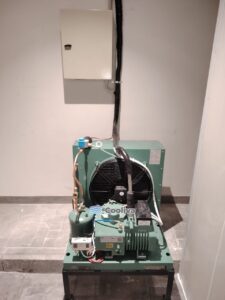
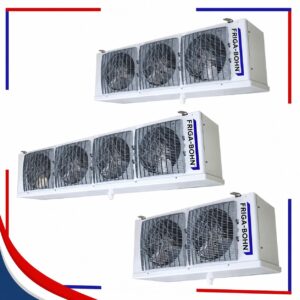
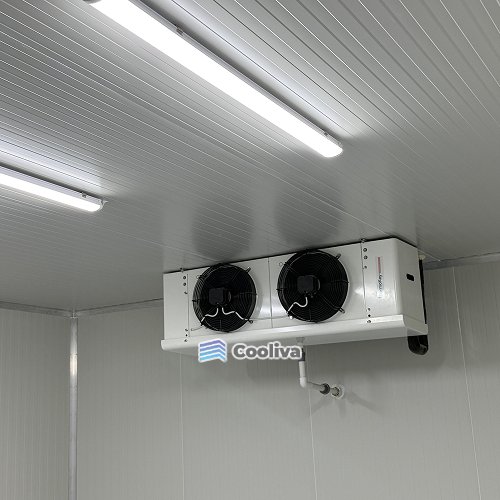
- Evaporator. Chiller evaporators have closely spaced fins and often rely on air defrost. Below 0 °C frost bridges the fins and blocks the airflow. Freezer evaporators use wider fin spacing, electric or hot gas defrost and a heated drain line.
- Compressor. A condensing unit selected for chiller duty loses a large part of its capacity at freezer evaporating temperatures. It may also run outside the range its manufacturer approves.
Force the setpoint down and the compressor runs nonstop, the room usually stalls above -18 °C and ice appears at the door. A real conversion means replacing or upgrading the panels, floor, door and refrigeration system. Ask for two quotations: the conversion and a new freezer room. Our guide to freezer room design in Saudi Arabia covers each component.
When your business needs both
Many businesses run cold rooms and freezer rooms side by side. A restaurant keeps vegetables and dairy chilled and meat and fries frozen. A supermarket supplies chilled and frozen aisles. Meat, poultry and seafood suppliers sell fresh and frozen lines. You have two options: two separate rooms or one structure with two chambers, built as a multi-chamber cold room.
How the combined layout works
In the most common combined layout you reach the freezer through the chiller. The chiller acts as an airlock for the freezer.
- The freezer door opens into air at about +2 °C instead of hot outdoor or kitchen air. Less heat and less moisture enter with every opening.
- Less moisture means less frost on the freezer evaporator and less ice around the door.
- The wall between the chambers faces a cold room, so heat gain through it drops.
- Each chamber keeps its own evaporator and temperature control.
The layout has a price. All freezer traffic crosses the chiller, so you lose shelf space to an aisle and the chiller door works harder. With pallet traffic or a busy freezer, a separate freezer door behind an anteroom at +2 to +8 °C serves better.
Which one do you need?
- Products that arrive fresh and leave within their chilled shelf life: a chiller room.
- Products that arrive frozen and stay frozen: a freezer room.
- Both groups on one site: two chambers.
- Fresh or cooked product you want to freeze yourself: a blast freezer first, then a freezer room. A storage freezer is not built to freeze warm product fast.
If your stock goes beyond these cases, our cold room selection guide compares six room types. For budgeting, read about cold room cost drivers in Saudi Arabia.
Frequently asked questions
Can a freezer room run as a chiller room?
The structure allows it. Thicker panels and an insulated floor do no harm at +2 °C. The refrigeration system is the limit, because a low temperature compressor and its expansion valve are selected for a different operating range. Ask a technician to check the equipment before you raise the setpoint.
Which room uses more electricity?
The freezer, for the same size. It works against a larger temperature difference, runs about 18 to 20 hours a day by design and adds defrost, door and drain heaters. As a rule of thumb, each 1 °C lower evaporating temperature costs roughly 2 to 4 percent more compressor energy. Set the freezer no colder than your product needs.
Does a freezer room need an anteroom?
Not always. A small freezer with light traffic works with a strip curtain and good door discipline. A busy freezer gains from an anteroom or an entrance through the chiller, because less warm humid air reaches the cold door.
Is -18 °C cold enough for ice cream?
Usually not. Ice cream is typically stored at -23 to -25 °C. If ice cream is part of your range, say so at the start, because the colder setting changes the equipment selection. Confirm the temperature with your supplier and the applicable SFDA requirements.
Chilled, frozen or both: plan it with Cooliva
Cooliva is based in Riyadh and builds chiller rooms, freezer rooms and combined two-chamber layouts for restaurants, supermarkets, food suppliers and warehouses. Tell us what you store, how much and how often your doors open. We review your site and propose the layout that keeps each product at its temperature. Send your details through the contact page or call +966 59 799 1000.