A freezer room needs every check a chilled room needs plus a set of its own, because below zero every bit of moisture turns into ice. The key inspection points are the defrost system, the door frame heater and gasket, the drain line heater, the pressure relief valve, the floor and the safety release. This freezer room maintenance checklist explains what to inspect, how to read the ice you find and what never to do.
What changes below zero
Condenser cleaning, electrical checks and the daily temperature log are the same for every room. You will find them in our cold room maintenance plan. A chiller room forgives a door left open for a minute. A freezer turns that minute into frost on the coil and ice on the floor.
Start by reading the ice
Ice is the freezer’s own fault report. Where it forms tells you which part to inspect.
- Thin, even white frost on the evaporator fins. Normal between defrosts.
- Hard, clear ice on the coil or in the drain pan. Meltwater has refrozen. The defrost is incomplete or the water cannot drain.
- Ice on the floor inside the door. Humid air or water gets in at the door. Loose snow on the ceiling and on cartons near the door also comes from humid air.
- A frost line along a panel joint. Air is leaking through that joint. Moisture that enters a panel turns to ice and ruins the insulation, so report it early.
The defrost system
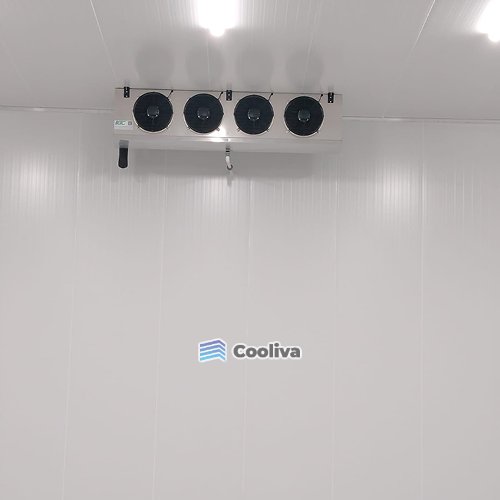
A freezer evaporator runs far below 0 °C, so moisture from the air freezes onto its fins. Frost insulates the coil and blocks the airflow. Electric heaters or hot gas melt it several times a day. Ask the technician to check three points at every visit:
- Heaters: every element works. One failed element leaves a block of ice in its section of the coil.
- Termination: on most systems a sensor on the coil ends the defrost when the ice has gone and a timer acts as backup. A defrost that always runs to the time limit signals weak heaters or too much frost.
- Schedule: too few defrosts let the coil block. Too many add heat and waste electricity. The right number depends on door traffic and humidity.
For background, read our article on how cold room evaporators work.
Door frame heater and gasket
A freezer door has a heater cable in its frame and often in the threshold. It stops the gasket from freezing to the frame. With the door open, the frame should be free of frost and slightly warm to the touch. A cold, frosted section means part of the heater has failed.
Check the gasket for tears, hardening and gaps at the corners. Then close the door on a strip of paper. If the paper slides out with no resistance, the seal is weak at that point. Our guide to choosing cold room doors helps when a door needs replacing.
Drain line heater
Defrost water must leave the room before it refreezes. The drain line inside a freezer needs a heater and a short sloped route to the outside. When the heater fails the pipe freezes solid, the pan overflows at the next defrost and ice builds under the evaporator.
Pressure relief valve
The air inside the room contracts as it cools after a door opening and expands during a defrost. A heated pressure relief valve lets air move in and out so the pressure on the panels stays balanced. A blocked valve shows itself in three ways: the door is hard to reopen after closing, air whistles at the gasket and ceiling panels creak or bow. Keep the valve free of ice and never tape it shut.
Floor: early signs of frost heave
Freezer rooms need an insulated floor. Large freezers built on the ground also need protection under the slab, either floor heating or ventilation pipes. If that protection is missing or fails, the ground below freezes over time, expands and lifts the floor. Watch for new cracks, a raised area in the middle of the room, racking that leans and a door frame that goes out of square. Keep the ends of ventilation pipes open and clear of sand. Our guide to freezer room design in Saudi Arabia covers the design side.
Safety release and alarm test
Every cold room door needs a release that opens it from the inside. In a freezer a stuck release puts a life at risk within a short time. Test it on a fixed schedule with a second person standing outside. The door must open from the inside even when it is locked. Check that neither stock nor ice blocks the release. Test the high temperature alarm too and check who receives it at night. Ask your safety officer which Civil Defense requirements apply to your site.
Freezer room maintenance checklist: symptom, likely cause and action
| Symptom | Likely cause | Action |
|---|---|---|
| Hard clear ice across the evaporator | Failed heater element, defrost ending too early or a blocked drain | Start a manual defrost. Book a technician to test the heaters, sensor and settings. |
| Ice in the drain pan or under the evaporator | Frozen drain line or failed drain heater | Have the heater tested and the line cleared. |
| Ice on the floor or snow on cartons near the door | Door held open, worn seal, failed threshold heater or missing curtain strips | Shorten door openings. Have the seal, heater and strips checked. |
| Gasket frozen to the frame | Failed frame heater | Have the heater circuit tested. Forcing the door tears the gasket. |
| Door hard to reopen, panels creaking | Blocked or unheated pressure relief valve | Clear the valve and test its heater. |
| Frost line on a panel joint | Air leaking through a failed joint seal | Have the joint resealed and the panel inspected. |
| Floor cracks, a raised area or leaning racks | Possible frost heave under the slab | Call for an assessment before the damage spreads. |
What never to do in a freezer room
- Never chip ice off the coil with a screwdriver, a knife or a hammer. One slip punctures a tube and the refrigerant escapes. Start a manual defrost and find the cause.
- Never hose a frozen floor or pour hot water on it. The water refreezes into a wider sheet of ice and runs into the floor joints, where it expands. Scrape the ice and sweep it out dry.
- Never switch off the door or drain heaters to save electricity.
- Never load warm product. A storage freezer holds frozen product. It is not built to freeze warm product fast.
- Never lower the setpoint to fight ice. Ice comes from moisture and failed heaters.
Frequently asked questions
How many defrosts a day does a freezer room need?
Several a day is typical. The exact number depends on door traffic, humidity and the evaporator. Coastal sites and busy doors need more. Let the technician set it from the frost found on the coil and do not change it yourself.
Is it normal for the temperature to rise during a defrost?
Yes. The air temperature near the evaporator rises for a short time while the heaters run. Product temperature changes far less. Report it if the room needs a long time to recover.
Do small restaurant freezer rooms need the same checks?
Yes for the defrost system, door heater, gasket, drain heater and safety release. Frost heave mainly concerns larger rooms built on the ground. A small room on insulated floor panels still needs its floor checked for damage and soft spots.
Book a freezer room inspection with Cooliva
Cooliva installs, upgrades and supports cold rooms and freezer rooms from its base in Riyadh. We work on freezer rooms for restaurants, supermarkets, food suppliers and warehouses. When ice keeps returning or panels and floors show damage, a site review shows whether a repair is enough or the room needs a refurbishment and upgrade. Send photos of the ice and the room dimensions through the contact page or call +966 59 799 1000.