Cold room design for the Saudi climate adds three things to a standard design. The condensing unit is selected for 46 to 50 °C outdoor air, not for the 32 or 35 °C found in many catalogues. The panels sit at the upper end of the thickness range and the equipment is protected against dust, coastal humidity and power faults. Skip these steps and the room holds temperature in January but struggles in August.
Climate factors and design responses
Climate is one input among several. The full sequence is in our article on the cold room design process. This table shows what the climate changes.
| Climate factor | Effect on the cold room | Design response |
|---|---|---|
| Summer air in the mid-40s °C | The condensing unit loses capacity and uses more power | Select the unit at a design ambient of 46 to 50 °C |
| Rooftops and sun-facing walls | Air around the unit is hotter than the forecast | Shade the unit and keep its air path free |
| Dust and sandstorms | Condenser fins clog and the compressor trips on high pressure | Accessible coil and cleaning after every storm |
| Coastal humidity in Jeddah and Dammam | More frost on the evaporator and corrosion on coils | Coated condenser coils and protected doors |
| Cool winter nights | Condensing pressure falls too low | Head pressure control through fan speed |
| Direct sun on outdoor rooms | Panel surfaces heat up far above air temperature | Canopy over the room and thicker panels |
| 60 Hz supply and voltage faults | Unsuitable motors and compressor damage | 60 Hz rated equipment and a protection relay |
Select the condensing unit for the real summer
A condensing unit rejects the heat of the room to the outdoor air. The hotter that air, the harder the compressor works and the less cooling it delivers. Standard catalogue ratings often assume outdoor air at 32 or 35 °C. Summer highs in Riyadh reach the mid-40s °C and rooftops run hotter still. Units for the Kingdom are commonly selected at a design ambient of 46 to 50 °C.
Ask every bidder one question: what capacity does this unit deliver at the design ambient and at my room temperature? Get the answer in writing. Energy follows the same physics. Each 1 °C rise in condensing temperature costs roughly 2 to 4 percent more compressor energy, so a generous condenser pays back every summer. Our article on cold room condensing units explains how these units work.
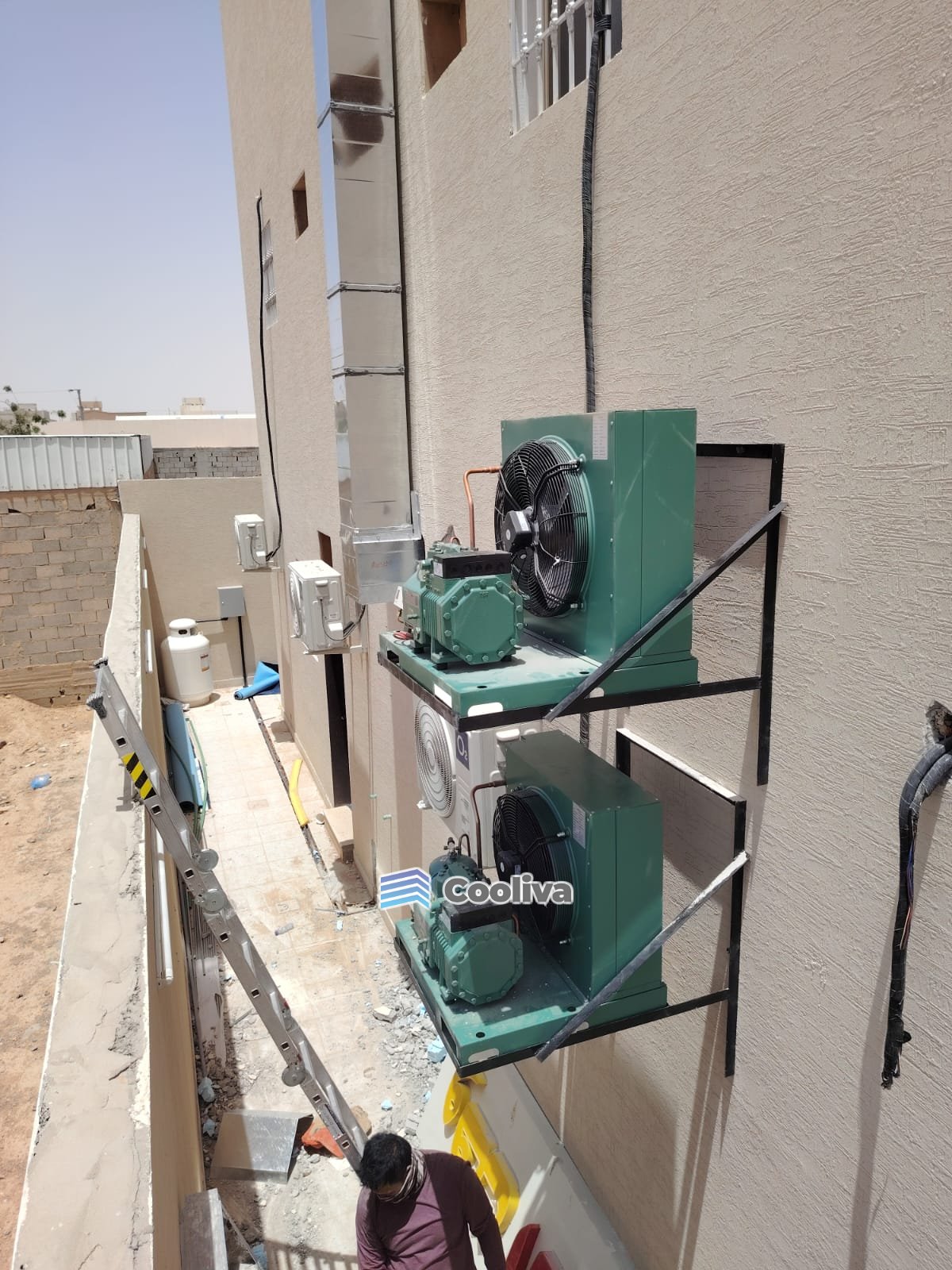
Give the unit shade and free air
Location decides how hot the air around the unit gets. A unit in a closed shaft breathes its own exhaust. A unit in full afternoon sun on a roof starts from a higher temperature than the forecast. Three rules help:
- Keep the air inlet and outlet clear, with the distances the manufacturer specifies.
- Shade the unit with a roof that lets air pass. Never box it in.
- Keep it away from kitchen exhausts, generators and other condensers that blow hot air at it.
Plan safe access as well. A unit nobody can reach does not get cleaned.
Dust and sandstorms: plan the cleaning
Dust settles between the condenser fins and works like a blanket. Airflow drops, pressure rises and the compressor trips on high pressure on the hottest afternoon of the year. A technician should clean the coil monthly to quarterly and again after each sandstorm. Design helps: choose a position where the coil can be reached and washed. Clean gently, because bent fins block air as surely as dust does.
Dry Riyadh, humid Jeddah and Dammam
Riyadh has a dry desert climate. A door opening there brings in heat but little moisture. On the coasts the picture changes. In Jeddah and Dammam humid air enters with every opening and its moisture freezes on the evaporator. The same humidity corrodes condenser coils.
For coastal sites ask for coated condenser coils. Protect the door with strip curtains or an air curtain and match the defrost schedule to the heavier frost load. Rooms below zero suffer most from humid air, as our article on freezer room design explains.
Cool winter nights and head pressure control
The unit that copes with the August heat meets cool nights in January. With a large condenser and cold air, the condensing pressure can fall too low. The expansion valve then lacks the pressure difference it needs to feed the evaporator and the room temperature drifts. Head pressure control prevents this. It slows the condenser fans to keep the pressure in a stable range. Ask whether your unit includes it.
Insulation: choose the upper end
Heat flow through a panel rises with the temperature difference across it. Chilled rooms typically use 80 to 100 mm panels and freezer rooms 120 to 150 mm. In the Kingdom choose the upper end, above all for rooms in warehouses without air conditioning. Seal the joints too. A continuous vapour barrier on the warm side keeps moisture out of the panels.
A room that stands outdoors needs a canopy. Direct sun heats the roof panels far above the air temperature and ages sealants and gaskets. A shade roof with an air gap removes that load.
Power: 60 Hz and compressor protection
Saudi Arabia uses 60 Hz power and many imported units are built for 50 Hz. A 50 Hz motor on a 60 Hz supply turns about 20 percent faster, which changes its capacity, current and wear. Accept only equipment that the manufacturer rates for 60 Hz. Larger units use a three-phase supply of 380 to 400 V. A phase and voltage protection relay stops the compressor when a phase fails or the voltage leaves the safe range.
Before each summer: a short checklist
- Clean the condenser coil before the heat arrives.
- Check the condenser fan motors and the fan speed control.
- Inspect door gaskets and strip curtains.
- Test the high temperature alarm.
- Confirm that nothing new blocks the airflow around the unit.
- Move large deliveries to the cooler hours where you can.
Frequently asked questions
Which design ambient temperature should I ask for in Riyadh?
Units in Riyadh are commonly selected at 46 to 50 °C. The right figure depends on where the unit stands. A shaded position at ground level sits lower in that range than a dark rooftop. Ask the contractor to state the figure in the quotation next to the unit capacity.
Why does my cold room trip on high pressure every summer?
The condenser cannot get rid of its heat. The usual causes are a dirty coil, hot air recirculating around the unit, a failed fan or a unit selected at a mild catalogue rating. Start with cleaning and airflow. If the unit is too small for the climate, a refurbishment or upgrade with a correctly selected unit is the lasting fix.
Can the condensing unit stand indoors, away from the heat?
Only with enough ventilation. The unit releases all the heat it removes from the cold room plus the heat of its own motor. In a closed space the air heats up quickly and the unit trips. An indoor position needs a path for fresh air in and hot air out.
Does a high-ambient design raise the price of a cold room?
It raises the purchase price somewhat. A larger condenser, thicker panels, coil coating and a canopy all cost money. The cheaper alternative tends to cost more later through higher electricity use, summer breakdowns and spoiled stock. Our article on what determines cold room cost in Saudi Arabia lists the other cost drivers.
Cooliva designs for the climate it works in
Cooliva is based in Riyadh and builds cold rooms and freezer rooms for kitchens, supermarkets, warehouses and industrial sites across the Kingdom. Its site review settles where the unit will stand, how it gets its air and which design temperature applies. The work covers new chiller rooms and freezer rooms as well as upgrades of rooms that struggle in summer. Share your location and products through the contact page or call +966 59 799 1000.