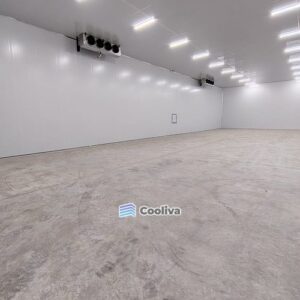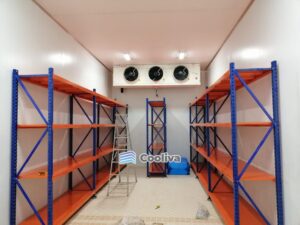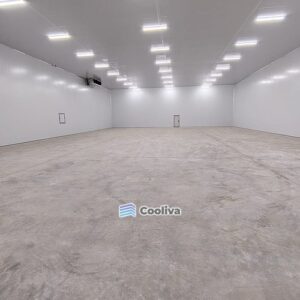
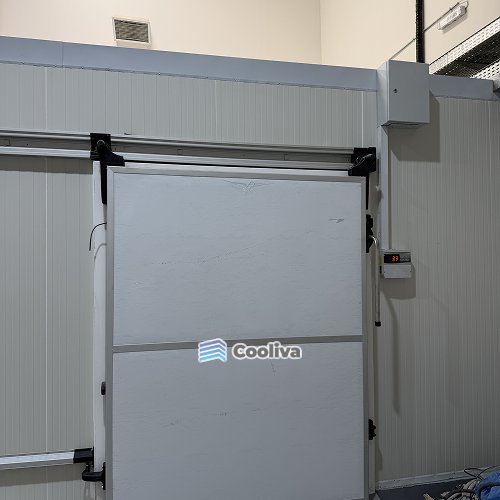
Freezer rooms in Riyadh need five things from the site before installation starts. They are a level floor, a clear route for the panels, open air for the outdoor unit, a drain point and 60 Hz power, three-phase for larger units. Because the room holds -18 °C or colder, it also needs an insulated floor, heaters on the door frame and drain line and a heated pressure relief valve. This guide follows the job from site check to handover.
Design basics in brief
Frozen food is typically stored at -18 °C or colder and ice cream at -23 to -25 °C. Confirm the figure with your supplier and the applicable SFDA requirements. Freezer panels are typically 120 to 150 mm thick and Riyadh’s heat calls for the upper end. The condensing unit is selected for high ambient, commonly 46 to 50 °C. For the reasoning behind these figures, read our freezer room design guide.
What your site must provide
Settle these points before the panels arrive.
| Requirement | What ready looks like |
|---|---|
| Level floor | Clean, level and able to carry the room, the stock and any pallet truck. Decide early where the insulated floor goes: on top of the slab with a ramp at the door or in a recess, flush with the building floor. |
| Access for panels | A clear route from the truck to the room. Measure doors, corridors, stairs and lifts against the longest panel. |
| Ventilation for the outdoor unit | Open air on the inlet and outlet sides, shade that leaves the airflow free and safe access for service. A closed shaft is not acceptable. |
| Drain point | A floor drain or waste pipe outside the room that defrost water reaches by gravity. |
| Power supply | 60 Hz. Larger units use three-phase 380 to 400 V. Provide a dedicated breaker and tell the installer the cable distance from your main board. |
Site conditions also move the price. A long cable run, a crane lift and night work in a mall each add to it. See our guide to cold room cost in Saudi Arabia.
Installation sequence in nine steps
- Site check. The installer measures the space, checks floor level and access and agrees the positions of the outdoor unit, the drain and the power point.
- Design approval. You receive a layout, a heat load summary and an equipment list. Check both design temperatures, room and outdoor, before you sign.
- Site preparation. Finish the floor levelling or recess, the power supply and the drain point before delivery. Agree in writing who does each task.
- Delivery. The team stores the panels flat and in the shade and checks each nameplate for the ordered model and 60 Hz.
- Floor, walls and ceiling. The insulated floor goes down first. Installers lock the wall and ceiling panels together and seal every joint on the warm side.
- Door and valve. Installers set the door frame plumb, connect the frame heater and fit the heated pressure relief valve.
- Refrigeration. Technicians hang the evaporator, fix the condensing unit outdoors, braze and insulate the pipes and seal each hole through the panels.
- Drain and electrics. They fit the heated drain line and wire the control panel, probes, defrost heaters, lighting and alarms.
- Testing and handover. They leak test, evacuate and charge the circuit, pull the room down to temperature and hand it over with documents and staff training.
Five freezer items an installer must not skip
A freezer room is not a chiller room with a lower setpoint. Below zero, water vapour turns to ice wherever it gets in and the air pressure inside shifts with each door opening. These five parts deal with both.
1. Insulated floor
Without floor insulation the slab gets cold, the system runs longer and the concrete around the room sweats. A large freezer on the ground also needs frost heave protection under the slab, by floor heating or ventilation. Read more in our guide to cold room insulation.
2. Door frame heater
Without a frame heater the gasket freezes to the frame, ice builds on the threshold and the door stops sealing. Freezer doors often need a threshold heater too.
3. Heated pressure relief valve
Warm air that enters through the door cools and contracts. The pressure inside drops, the door becomes hard to open and the panels take the strain. The valve balances the pressure and its heater stops it from freezing shut.
4. Drain line heater
Inside a freezer, defrost water refreezes in the drain pipe unless the pipe is heated. A blocked drain means ice in the pan, ice on the coil and water on the floor.
5. Defrost setup
Freezer evaporators use electric or hot gas defrost several times a day. The controller needs four settings: how often defrost starts, the coil temperature that ends it, a drip time and a fan delay. Ask the installer to set them for your door traffic and to show you the values.
Commissioning tests to witness
Ask to be present for the tests and to receive the results in writing.
- Leak test and vacuum: the circuit holds pressure under nitrogen, then holds a deep vacuum before charging.
- Pull-down: the empty room reaches its set temperature and the technician records the time.
- Defrost cycle: the heaters switch on, defrost ends on temperature, water runs out of the drain and the fans restart after the delay.
- Door and valve: the gasket seals all round, the frame heater works, the inside safety release opens the door and the relief valve moves freely.
- Electrics and alarms: the current on each phase sits within the nameplate rating, the high temperature alarm sounds and the display agrees with a reference thermometer.
The handover file should hold the layout, the wiring diagram, the controller settings and the commissioning record. One point is specific to Riyadh: a room commissioned in winter has not met summer yet. Ask for the operating pressures to be checked again in the first hot weeks. Then follow a regular freezer room maintenance routine.
Installation mistakes that show up in Riyadh’s heat
- A condensing unit chosen from catalogue ratings at 32 °C or 35 °C. Riyadh summers run hotter.
- Suction pipes crossing a hot roof with thin or sun-damaged insulation.
- Panel joints and pipe holes left unsealed. Moisture enters, turns to ice inside the panels and ruins the insulation.
- Brazing without nitrogen and a rushed vacuum. The first leaves scale in the pipes. The second leaves moisture that freezes at the expansion valve.
- Warm product loaded on the first day. A storage freezer holds frozen product. It is not built to freeze warm product fast, which is the job of a blast freezer.
Frequently asked questions about freezer rooms in Riyadh
Can I turn an existing chiller room into a freezer room?
Rarely by changing the setpoint. A chiller room typically has 80 to 100 mm panels, no floor insulation, no door or drain heaters and an evaporator built for air defrost. Ask a contractor to inspect the room before you decide.
Is single-phase power enough for a small freezer room?
Some small condensing units come in single-phase versions. Larger units need three-phase 380 to 400 V. In both cases the equipment must be rated for 60 Hz.
Why does ice form on the floor inside the freezer door?
Warm air enters at the door and its moisture freezes on the first cold surface. Check the gasket, the frame heater, the strip curtain and how long the door stays open. Report ice near the door early. It is a warning sign and a slip hazard.
Freezer room installation in Riyadh with Cooliva
Cooliva is based in Riyadh and builds cold rooms and freezer rooms for restaurants, supermarkets, food distributors and suppliers of meat, poultry and seafood. Freezer room installation runs from site review and solution planning to supply, testing and handover. Send your room size, products and site photos through the contact page or call +966 59 799 1000 to arrange a site check.