Choose a cold room door by the traffic that passes through it: hinged doors for people and trolleys, sliding doors for pallets and forklifts and rapid roll doors where traffic is heavy. The door is the only part of the room that opens, so a large share of avoidable cooling loss happens there. This guide covers the main cold room door types, how to size the opening and the add-ons and habits that keep the cold inside.
What happens each time the door opens
Cold air is heavy. When the door opens it spills out along the floor and warm air flows in at the top to replace it. That warm air carries moisture. In a chiller room the moisture ends up as frost on the evaporator. In a freezer it also becomes ice on the floor, the ceiling and the door frame. The compressor runs longer, the evaporator needs more defrosts and the room takes time to recover. The loss grows with the size of the opening and the minutes it stays open. For the wider picture, read our guide to cold room energy efficiency in Saudi Arabia.
Cold room door types by use
Hinged doors
A hinged door swings on hinges and presses its gasket against the frame. It is simple and seals well. Use it for people on foot and for trolleys. It needs free floor space in front for the swing.
Sliding doors
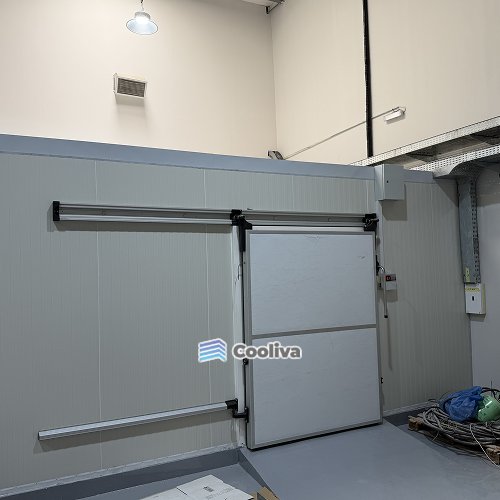
A sliding door runs on a track beside the opening. It suits wide openings for pallet trucks and forklifts and needs no swing space. Manual versions suit moderate traffic. Motorised versions suit frequent traffic. Our earlier guide compares sliding and hinged cold room doors point by point.
Rapid roll doors
A rapid roll door has a flexible curtain that opens and closes in seconds when a sensor or pull cord triggers it. It suits heavy forklift traffic, where a slower door would stand open for most of the shift. On freezers it often works together with an insulated door that closes the opening at night.
Traffic doors
Traffic doors are light swing doors that open when a trolley pushes them and close by themselves. They do not seal or insulate like a cold room door. Use them between chilled work areas and corridors or as a second barrier behind the main door during working hours.
Match the door to your traffic
| Traffic type | Recommended door | Add-ons |
|---|---|---|
| Staff on foot in a restaurant or shop walk-in | Hinged door | Strip curtain, door-open alarm |
| Trolleys and roll cages | Wide hinged door or small sliding door with a flush threshold | Kick plate, strip curtain, fan stop switch |
| Pallet trucks, moderate traffic | Manual sliding door | Strip curtain, guard posts, door-open alarm |
| Forklifts, frequent passes | Motorised sliding door plus rapid roll door | Air curtain, guard posts, anteroom on freezers |
| Constant movement between chilled work areas | Traffic door | Vision panel, bumper plates |
| Any freezer room | The matching door above in a freezer version | Frame heater, threshold heater, heated pressure relief valve |
Size the opening for what passes through
Start with the widest and tallest load, then add clearance on both sides and above. Common pallets measure 1.2 x 1.0 m and 1.2 x 0.8 m, so decide which side enters first. For forklifts, check the mast height with the forks lowered and the height of the tallest load.
- Ask for the clear opening in the offer, not the size of the door leaf.
- Ask for a flush threshold where wheels cross. A floor panel raises the freezer floor, so plan a ramp or a recessed slab.
- Do not oversize. Every extra square metre of opening lets in more warm air.
What a freezer door needs
Below zero, any moisture at the door turns to ice. Freezer doors need a frame heater so the gasket does not freeze to the frame. Many also need a threshold heater. A heated pressure relief valve balances the pressure after each opening. Without it the door can be hard to open for a minute and the gasket takes the strain. On freezer rooms with heavy traffic, an anteroom at +2 to +8 °C in front of the door keeps humid outside air away.
Gaskets and the inside safety release
The gasket is the soft seal around the door. It must touch the frame along its full length. Test it with a sheet of paper: close the door on the paper and pull. If the paper slides out freely, the seal is weak at that point. Replace torn or hardened gaskets early. The door frame is also a thermal bridge. Our guide to cold room insulation explains why that matters.
Every cold room door needs an inside safety release that opens the door from inside even when it is locked from outside. Test it regularly, keep it free of ice and show it to every new member of staff.
Add-ons that cut losses
- PVC strip curtains hang behind the door and cut the air exchange while people pass. Freezers need strips that stay flexible in the cold. Replace strips that are torn, stiff or cloudy.
- Air curtains blow a sheet of air across the opening. They suit forklift doors where strips get in the way. They need correct adjustment to work.
- Door-open alarms sound after the door has stood open for a set time.
- A door switch can stop the evaporator fans while the door is open, so they do not push cold air out.
Staff habits that cost nothing
- Close the door behind you every time. Never prop it open during a delivery.
- Collect what you need for the next hours in one trip.
- Stage deliveries in front of the door, then load in one go.
- Leave strip curtains hanging. Never tie them aside.
- Report ice, torn gaskets and doors that do not close on the day you see them.
Door maintenance
Doors hold the only moving parts in the envelope, so they wear first.
- Daily: check that the door closes fully and that no ice builds on the frame or the floor.
- Weekly: check gaskets and strip curtains and wipe them clean.
- At each technician visit: hinges or rollers and tracks, the closer, frame and threshold heaters, the safety release and the alarm switch.
See also our guide to freezer room maintenance.
Frequently asked questions
Why does my freezer door freeze shut?
Three causes are common: a failed frame heater, a damaged gasket that lets moist air reach the frame and a blocked pressure relief valve. Check them in that order. Do not lever the door open with tools, because that tears the gasket and bends the frame.
Strip curtain or air curtain: which works better?
Strip curtains are simple and work well on doors used by people and trolleys, as long as they are intact and left hanging. Air curtains suit forklift doors and areas where strips are a hygiene or visibility concern. Neither replaces a closed door.
Can I replace the door on an existing cold room?
Yes. A door and its frame can be replaced without rebuilding the room when the surrounding panels are sound. The opening can often be widened at the same time. Check the simple fixes first: a new gasket, closer or heater often solves the problem.
Can I lock my cold room at night?
Yes, as long as the inside safety release still opens the door when it is locked. Never add a padlock or a bar that blocks the release.
Door selection and upgrades with Cooliva
Cooliva is based in Riyadh and designs, supplies and installs cold rooms and freezer rooms, from a restaurant walk-in cold room to warehouse cold storage with forklift traffic. The door is chosen during solution planning, once we know what passes through it and how often. Existing rooms can be upgraded with a new door, strip curtains or alarms. Tell us about your traffic through the contact page or call +966 59 799 1000.