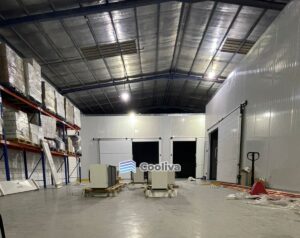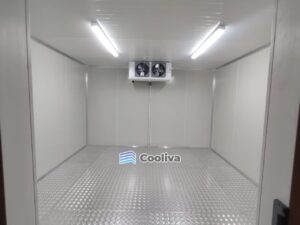

Cold rooms for supermarkets work as a set, not as one big room: produce, dairy, meat and frozen goods each need their own temperature. Size the rooms for your busiest delivery week and place them between the receiving dock and the sales floor. This guide covers the room list, the receiving flow, doors, Ramadan capacity, night restocking, energy and monitoring.
One room per department
Each product group has its own temperature, so divide the back of house into chambers that sit side by side. Produce, dairy and meat each get a chiller room at their own setpoint and frozen goods get a freezer room.
| Department | Typical temperature | Notes |
|---|---|---|
| Leafy greens, apples, grapes, carrots | 0 to +2 °C at 90 to 95 % humidity | High humidity stops produce drying out |
| Chilling-sensitive produce | Bananas +13 to +14 °C. Cucumbers +10 to +12 °C. Ripe tomatoes +8 to +10 °C. Mangoes +10 to +13 °C | Cold damages them. They need a warmer room than other produce |
| Dairy | +2 to +4 °C | Short shelf life. Rotate by expiry date |
| General chilled food | 0 to +4 °C | Packed deli items and ready meals |
| Fresh meat and poultry | -1 to +2 °C | Separate room. Cutting rooms commonly run at +10 to +12 °C |
| Fresh fish | Around 0 °C | Often kept on ice. Needs drainage and its own space |
| Frozen food | -18 °C or colder | Insulated floor and heated door frame |
| Ice cream | -23 to -25 °C | Colder than other frozen goods |
These are typical values. Confirm each one with your suppliers and the applicable SFDA requirements.
One more rule shapes the produce area. Ethylene producers such as apples, bananas and tomatoes damage sensitive items such as leafy greens and cucumbers when they share a room. Our guides to cold storage for fruits and vegetables and cold rooms for meat, poultry and seafood go deeper.
Receiving: from truck to room to shelf
- Check before you accept. The receiver measures product temperature with a probe thermometer and records it.
- Unload chilled and frozen goods first. A pallet left on an open dock in a Riyadh summer warms fast.
- Use a cooled receiving area if you have one. Docks and anterooms typically run at +2 to +8 °C.
- Split mixed pallets by department and send each part to its room.
- Put new stock behind old stock. Keep cartons off the walls and clear of the evaporator air stream.
- Replenish the sales floor in small loads so display cabinets are never filled above their load line.
The shorter this path, the less time product spends in warm air. Arrange the rooms so stock moves in one line from dock to room to sales floor without crossing customer areas.
Pallet access and door choice
Deliveries arrive on pallets of 1.2 x 1.0 m or 1.2 x 0.8 m. Every opening on the route has to take a loaded pallet truck: the dock door, the room door and the aisle inside. Ask the contractor to draw the turning path on the plan. Then match each door to its traffic:
- Hinged doors for people, trolleys and roll cages.
- Sliding doors for pallets and forklifts.
- Rapid roll doors for openings with heavy traffic.
- Strip curtains or air curtains behind doors that open often.
- Heated frames on freezer doors, often with a heated threshold.
- A safety release inside every door.
Pallet trucks hit walls, so protect panels and door frames with kick plates and bumper rails.
Capacity for Ramadan and other peaks
Supermarket cold rooms face their hardest test in the weeks before and during Ramadan. Deliveries grow for products such as dairy, juices, dates and frozen foods, while shopping hours stretch late into the night. Size for that peak week, not the average week:
- Ask your buyers for last Ramadan’s largest daily delivery per department, in pallets.
- Decide how many days of stock you hold at peak. More frequent deliveries reduce the room you need.
- Consider one room that can run at either chilled or frozen temperature. Decide this at design stage, because it changes the panels, the floor, the door and the refrigeration.
- Leave space and electrical capacity for an extra chamber.
An overfilled room is a warm room. Pallets stacked against the evaporator block the air and the far corners heat up.
Night restocking
Many stores fill their shelves at night or in the early morning, when the aisles are empty. For the cold rooms this means a few hours of constant door openings followed by a long quiet period.
- Pick by aisle onto roll cages inside the room, then leave once. Many short trips let in more warm air than one planned trip.
- Close the door between trips. A door-open alarm reminds staff.
- Schedule freezer defrosts outside the restocking window.
Energy: the largest running cost
Electricity is typically the largest running cost of a store’s cold rooms. As a rule of thumb, each 1 °C of higher condensing temperature or lower evaporating temperature costs roughly 2 to 4 % more compressor energy. Dirty condensers, open doors, damaged gaskets and frosted evaporators waste the most. What helps:
- Setpoints no colder than the product needs.
- Condenser coils cleaned on schedule and after sandstorms.
- Condensing units selected for 46 to 50 °C ambient and shaded without blocking airflow.
- EC fans, LED lighting and demand defrost.
- Door discipline, strip curtains and intact gaskets.
With several rooms you also choose between one central system for all chambers and a separate condensing unit per room. A central system shares capacity between rooms. Separate units limit a fault to one room. More measures are in our guide to cold room energy efficiency.
Monitoring several rooms from one screen
Five rooms mean five temperatures, five doors and five ways to lose stock overnight. A central monitoring system shows every room’s temperature, door status and alarms on one screen and sends alerts to the duty manager’s phone.
- Set a high temperature alarm for each room, with a short delay so a defrost or a delivery does not trigger it.
- Agree who answers an alarm at 3 am and who gets the next call.
- Keep the logs. Municipality and SFDA inspections commonly ask for temperature records, so check the current requirements for your store.
- Keep the daily walk-round: display temperatures, doors closing fully, no ice, no unusual noise and no water leaks.
See also our guide to temperature monitoring in cold rooms.
Supermarket cold room FAQ
How many cold rooms does a supermarket need?
Count your departments. A full-range store usually plans at least four: produce, dairy and general chilled, meat and frozen. Fish, bakery dough and chilling-sensitive produce can add more. A small grocery may manage with one chiller and one freezer.
What happens to the stock if one room breaks down?
Several chambers give you somewhere to go. Staff move product to a neighbouring room at a similar temperature while the technician works, as long as that room is not overloaded. An early alarm and a service contract with a clear response time decide how much you save.
Do dates need cold storage before Ramadan?
Dates store well near 0 °C and are frozen at -18 °C for long storage. A store that buys its Ramadan stock early should plan chilled space for it. Confirm the conditions with your supplier.
Back-of-house cold rooms by Cooliva
Supermarkets, groceries and food distributors are among the businesses Cooliva serves from Riyadh with cold rooms and freezer rooms. For a store we plan multi-chamber cold rooms: produce, dairy, meat and frozen rooms side by side, each at its own temperature. The work starts with your department list, your delivery schedule and a review of the back-of-house area, followed by supply, installation, testing and handover. To discuss a new store or an upgrade, use the contact page or call +966 59 799 1000.