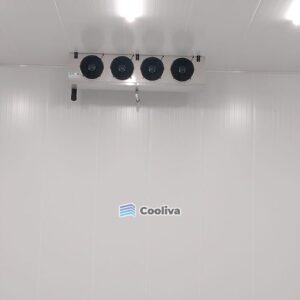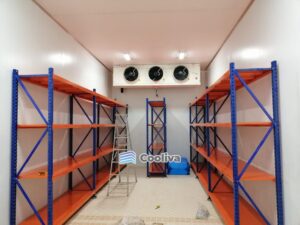
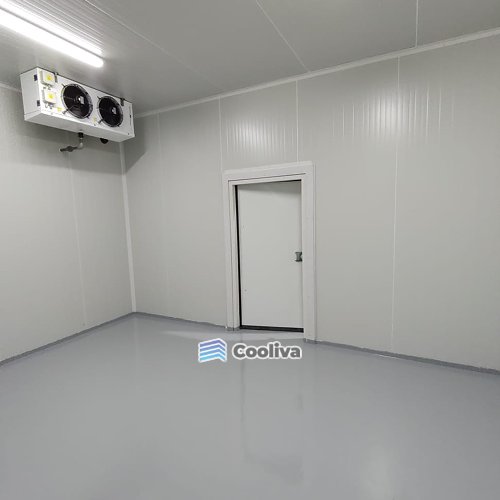
A cold room panel is a sandwich: a rigid foam core bonded between two metal skins. When you compare offers for cold room sandwich panels, five things decide the quality: the core (PUR or PIR), the skins, the joint system, the thickness and the floor build-up. This guide shows what to ask for, what to check when the panels arrive and how to keep them in service for many years.
What a cold room sandwich panel does
The panel is wall, insulation and vapour barrier in one piece. The foam stops heat. The metal skins keep moisture out, carry the load and give you a washable surface. For the physics behind thickness, moisture and thermal bridges, read our guide to cold room insulation.
PUR or PIR core
Most cold room panels use polyurethane (PUR) or polyisocyanurate (PIR) foam. Both are rigid closed-cell foams with a density of about 40 kg/m³ and a similar insulation value. They differ in how they behave in a fire.
| Property | PUR | PIR |
|---|---|---|
| Thermal conductivity | About 0.022 to 0.024 W/m.K | About 0.022 to 0.024 W/m.K |
| Fire behaviour | Burns more readily once the foam is exposed | Forms a char layer that slows flame spread |
| Typical use | Small and medium rooms inside buildings | Warehouses, large rooms and sites with stricter fire requirements |
| Price level | Usually lower | Usually higher |
Some low-cost rooms use expanded polystyrene (EPS). It insulates less well at the same thickness, so it needs thicker panels for the same result. Ask which core you are being offered. Panel type and thickness are among the main cost drivers. See what determines cold room cost in Saudi Arabia.
Metal skins: painted steel or stainless steel
The standard skin is pre-painted galvanized steel, commonly about 0.5 mm thick and usually white. It suits most chilled and frozen storage. Stainless steel earns its place in hygiene areas: meat and fish preparation, rooms washed down every day and areas cleaned with aggressive chemicals. A common compromise is stainless steel inside and painted steel outside.
Ask three things about the skins: the metal and its thickness, the coating and whether the inside face is approved for food areas.
Joint systems: cam-lock or tongue and groove
- Cam-lock. Hooks set into the panel edge pull two panels together when the installer turns a key. Assembly is fast. The room can be dismantled, moved or extended later. Walk-in and modular rooms use this system.
- Tongue and groove. One profiled edge slides into the next and the panels are fixed to a supporting frame. Long wall and ceiling panels for warehouses are usually made this way. They are not meant to be taken apart.
Both systems depend on the sealant in the joint. A lock that is not fully turned or a joint without sealant leaks heat and moisture from the first day.
Thickness and density: what to put in writing
Chiller rooms typically use 80 to 100 mm panels, freezer rooms 120 to 150 mm and blast freezers 150 to 200 mm. In Saudi heat choose the upper end. Ask the supplier to state these points in the offer:
- Core type: PUR, PIR or EPS.
- Thickness of walls, ceiling and floor.
- Foam density, typically about 40 kg/m³.
- Thermal conductivity from the manufacturer’s data sheet.
- Skin metal, skin thickness and coating on both faces.
- Joint system and sealant.
Floor panels and floor finishes
Freezer rooms need an insulated floor. The build-up depends on what rolls over it:
- Foot traffic and hand trolleys: insulated floor panels with a reinforced anti-slip top, commonly plywood under stainless steel or aluminium chequer plate.
- Forklifts and heavy pallet traffic: insulation boards under a reinforced concrete slab. Standard floor panels are not built for forklift wheel loads.
- Small chilled rooms: sometimes no floor panel. The wall panels sit in a channel fixed to the existing floor.
A floor panel raises the floor by its own thickness. Plan a ramp or a recessed slab so trolleys do not meet a step at the door. Ask for a coved junction between floor and wall, which is easier to clean.
Fire performance
PIR performs better in a fire than PUR. No foam core is fireproof. Ask for the panel’s fire test report or classification and check Civil Defense requirements for your building before you order. Protect the panels in daily use too. Keep welding and cutting away from them, run cables through sealed sleeves and never leave foam exposed at a cut edge.
What to check on delivery
- Measure the thickness and compare the labels with the offer.
- Look along each panel. It should be straight and flat, because a bowed panel does not close at the joint.
- Inspect the skins for dents, deep scratches and punctures.
- Check edges and corners. A crushed tongue or groove will not seal.
- Tap the surface. A hollow sound means the skin has separated from the foam.
- Store panels flat, off the ground and in the shade. Peel off the protective film soon after installation, before the sun bakes it onto the skin.
What to check during installation
- The base is level before the first panel goes up.
- Sealant goes into every joint before the panels are locked.
- Every cam-lock is fully turned and its cap is fitted.
- Walls are plumb and joint gaps are even from top to bottom.
- Holes for pipes and cables are cut cleanly and sealed, with no foam left exposed.
- Evaporators, shelving and lights hang from proper supports, not from screws in the skin.
- The door frame sits square and the door seals all round. See our guide to cold room doors.
Service life and care
Panels have no moving parts. With sealed joints and undamaged skins they commonly outlast the refrigeration machinery. Four habits protect them:
- Fit kerbs, bump rails or bollards where trolleys and forklifts pass.
- Seal any puncture the day it happens.
- Clean with products the panel supplier approves. Abrasive pads and harsh chemicals strip the coating.
- Keep stock off the walls. This helps air circulation and prevents impact damage.
Frequently asked questions
Is a cold room panel the same as a normal sandwich panel?
Not quite. Roof and wall sandwich panels for sheds and hangars are built for weather protection. They are usually thinner and their joints are not designed to stay vapour-tight around a room at 0 °C or -18 °C. Cold room panels have thicker cores, tight joint systems and an inside face suited to food areas. Ask for panels made for cold storage.
Can cold room panels be dismantled and reused at another site?
Cam-lock panels can, as long as they are dry and undamaged. Each panel needs inspection and every joint needs new sealant. The refrigeration unit must be checked against the new location too, because a room moved from an air-conditioned kitchen to a hot warehouse faces a higher heat load. See also our guide to cold room upgrade and expansion.
Can panels be installed outdoors under the sun?
Yes, with protection. Ceiling panels are not a roof. An outdoor room needs a canopy or a roof above it to keep sun and rain off the ceiling and the joints. Choose the upper end of the thickness range and expect the sealant on sun-exposed walls to need earlier renewal.
Can I cut a new door or window into an existing panel wall?
Yes, but treat it as a specialist job. The opening needs a frame, every cut edge must be sealed and hidden cables or pipes must be located first. In a freezer the new door frame also needs a heater.
Panels supplied and installed by Cooliva
Cooliva is based in Riyadh and supplies and installs complete cold rooms and freezer rooms, panels included. Rooms that do not fit a standard size are built as custom designed cold rooms. Tell us the room size, the storage temperature and where the room will stand, so the panel specification fits the site. Use the contact page or call +966 59 799 1000.