Freezer room design in Saudi Arabia is not chiller room design with a lower setpoint. Below 0 °C moisture turns to ice, so the floor, the door, the drain and the evaporator all need protection that a chilled room does without. This article follows the design from the target temperature to daily operation and explains why each freezer detail exists.
Start with the target temperature
Frozen food is typically stored at -18 °C or colder. Ice cream needs -23 to -25 °C. Dates for long storage are commonly frozen at -18 °C. Confirm the value for each product with your supplier and the applicable SFDA requirements. Our reference on cold room temperature by product covers chilled goods as well.
That figure is a product limit, not a controller setting. Operators commonly set the room a few degrees colder so that door openings and defrost cycles do not push stock above the limit. Keep the margin small. Each degree lower in evaporating temperature costs roughly 2 to 4 percent more compressor energy.
What a freezer needs that a chiller does not
The general steps, from heat load to documentation, are the same as in our cold room design process. The table lists what is added below zero.
| Design item | Why a freezer needs it |
|---|---|
| Panels of 120 to 150 mm | The temperature difference to the outside is far larger than in a chiller |
| Insulated floor | An uninsulated slab leaks heat into the room around the clock |
| Frost heave protection | Soil under a large freezer can freeze, expand and lift the slab |
| Continuous vapour barrier | Moisture that gets into a panel turns to ice and ruins the insulation |
| Door frame heater | Without heat the gasket freezes to the frame |
| Heated pressure relief valve | Balances the pressure after door openings and defrost without freezing shut |
| Electric or hot gas defrost | Room air is below zero and cannot melt frost off the coil |
| Wider fin spacing | Frost can build between defrosts without blocking the airflow |
| Drain line heater | Meltwater refreezes in an unheated pipe and blocks it |
| Anteroom for larger rooms | A chilled buffer keeps warm, humid air away from the freezer door |
| Inside release and trapped person alarm | Nobody should stay locked in at -18 °C |
Panels, floor and vapour barrier
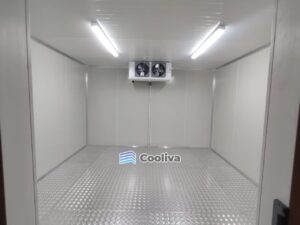
Freezer rooms typically use insulated panels of 120 to 150 mm with a PUR or PIR foam core. Chilled rooms manage with 80 to 100 mm. The arithmetic explains it. A chiller at +2 °C in a 40 °C warehouse faces a difference of 38 degrees. A freezer at -20 °C in the same warehouse faces 60. In hot climates choose the upper end of the range.
The floor needs insulation as well. Under a large freezer on the ground, cold creeps down through the slab. Moisture in the soil freezes, expands and lifts the floor. Engineers call this frost heave. Heating or ventilation under the slab prevents it.
The vapour barrier matters as much as the foam. Water vapour pushes from the warm side toward the cold side. Where it finds a gap at a joint or a pipe entry, it enters the panel and freezes. Seal every joint and penetration on the warm side. A tight room also has to equalise pressure. When the door closes on warm air, that air cools and shrinks. A heated pressure relief valve lets air in and out and stays free of ice.
Doors and the anteroom
A freezer door needs a heater in the frame and often one in the threshold. Without them the gasket freezes to the frame, the seal tears and ice grows around the opening. Add a PVC strip curtain and a door-open alarm.
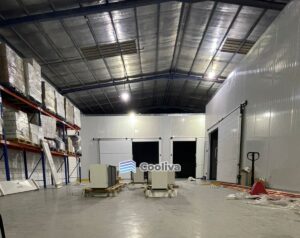
For a larger room with frequent traffic, plan an anteroom in front of the door. It is a chilled space, commonly held at +2 to +8 °C. Pallets wait there instead of in a hot dock and the freezer door opens onto cool air. Less moisture gets in, so less frost forms on the evaporator and less ice on the floor.
Evaporator, defrost and drain
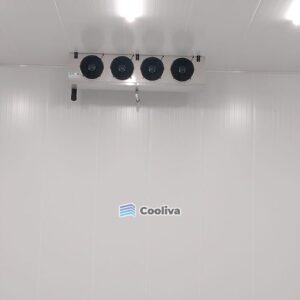
Frost forms on every freezer evaporator. The design decides how the system gets rid of it. Freezer evaporators use wider fin spacing than chiller evaporators, which gives frost room to build before it chokes the airflow. Defrost runs several times a day with electric heaters or hot gas, more often where humid air gets in. A sensor on the coil typically ends each defrost once the ice has gone. A short fan delay then keeps meltwater from blowing onto the product.
The meltwater leaves through a heated drain line that takes the shortest route out of the room. Designers size freezer refrigeration for about 18 to 20 running hours per day, which leaves time for defrost. The outdoor unit has to hold its capacity through the summer, a point we cover in cold room design for the Saudi climate.
Lighting and safety
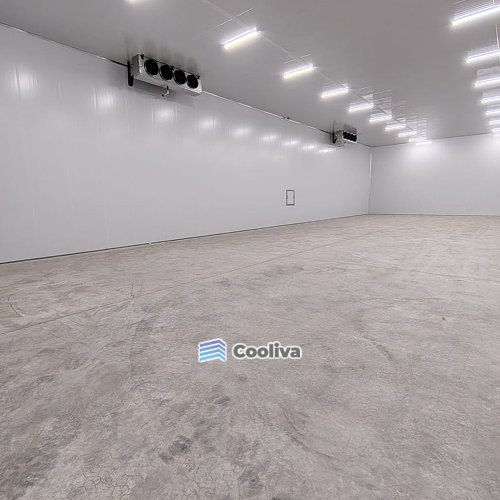
Use LED fittings rated for low temperatures. They start instantly in the cold and add little heat. Fit an inside release on every door and a trapped person alarm that sounds where staff will hear it. Provide insulated clothing and gloves for anyone who works inside. Check the Civil Defense requirements for your building.
Loading: frozen or warm product?
A storage freezer holds frozen product. It is not built to freeze warm product fast. Chilled meat loaded into a -18 °C room freezes slowly and warms the stock around it for hours. Slow freezing also forms large ice crystals that damage texture. The benchmark for blast freezing is a core temperature of -18 °C within about 240 minutes, with air at -30 to -40 °C. If you freeze product yourself, put a blast freezer ahead of the storage room or state the daily freezing quantity in your design brief.
Product that arrives frozen is simpler. Check its temperature at the door, move it inside without delay and stack it clear of the walls and below the evaporator air stream.
Daily operation: what a good design makes easy
- Read the display temperature at the start of each shift.
- Look for ice on the floor near the door and heavy frost on the evaporator.
- Check that the door closes fully and that the gasket is intact.
- Book a technician to check defrost heaters, the drain heater, door heaters and panel joints.
Our guide to freezer room maintenance sets out the full schedule.
Frequently asked questions
Can I turn an existing chiller room into a freezer room?
Not by lowering the setpoint. A chiller has thinner panels and no heaters on the door or drain. Its floor is often uninsulated and its evaporator is usually built for air defrost. Its compressor was also selected for a higher evaporating temperature. A conversion replaces most of these parts, so have the room assessed first.
Why does ice build up on the floor inside the freezer door?
Warm, humid air enters each time the door opens. Its moisture condenses and freezes on the coldest surfaces near the opening. Common causes are a door left open, a torn gasket, a failed frame heater or a missing strip curtain. Fix the cause. Chipping the ice away only treats the symptom.
Does a small walk-in freezer need heating under the floor?
Every freezer needs an insulated floor. Heating or ventilation under the slab is typically specified for larger rooms that stand on the ground and run all year. For a small walk-in the designer checks what lies beneath the floor and decides case by case.
Plan your freezer room with Cooliva
Cooliva designs, supplies and installs freezer rooms for restaurants, supermarkets, food suppliers and warehouses from its base in Riyadh. Many sites need cold rooms and freezer rooms side by side. A chiller room in front of the freezer can then double as its anteroom. Tell us your products, your daily quantities and whether stock arrives frozen. Use the contact page or call +966 59 799 1000.