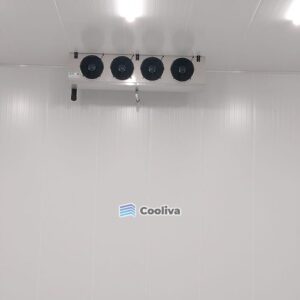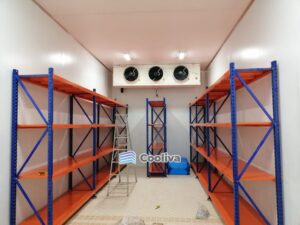
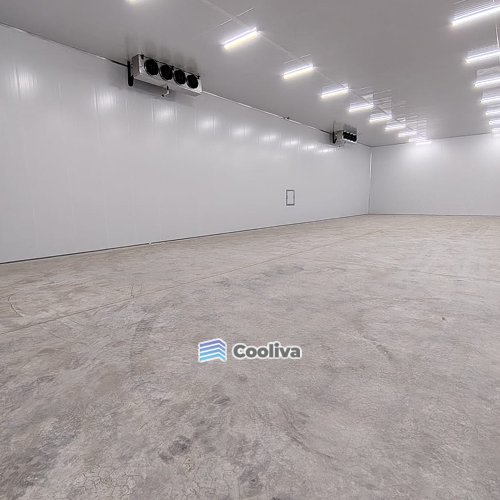
Designing a cold room in Saudi Arabia requires more than selecting a refrigeration unit and insulated panels. The room must be designed around the products being stored, required temperature, storage capacity, ambient conditions, door usage and expected operating conditions.
For restaurants, supermarkets, central kitchens, food suppliers, warehouses and industrial facilities, the right cold room design can help maintain stable temperatures, protect products and improve operating efficiency.
Cooliva provides cold room solutions across Saudi Arabia, including design, supply, installation, upgrades and modifications for commercial and industrial applications.
What Is a Cold Room?
A cold room is an insulated, temperature-controlled space designed to store products within a specific temperature range.
Depending on the application, a project may require:
- Chiller rooms
- Cold rooms
- Freezer rooms
- Blast freezers
- Blast chillers
- Walk-in refrigeration rooms
- Cold storage warehouses
The correct solution depends on the product, storage temperature and operating requirements.
What Temperature Should a Cold Room Be?
There is no single temperature suitable for every cold room.
The required temperature depends on the product and applicable storage requirements.
For food businesses, the Saudi Food and Drug Authority advises maintaining refrigerators at 5°C or below for food safety.
For frozen applications, -18°C is commonly used for frozen-food storage, although the required temperature should always be determined according to the product and applicable requirements.
SFDA materials also define different temperature ranges for different storage conditions, showing why the refrigeration system should be designed around the actual application rather than using one standard temperature for every project.
Typical applications
Application Typical temperature
Chilled food storage Around 0°C to +5°C
Refrigerated storage Application dependent
Frozen food storage Around -18°C
Blast freezing Application dependent
Important: These are general reference ranges, not universal design specifications.
Why Cold Room Design Matters in Saudi Arabia
Saudi Arabia’s climate creates additional challenges for temperature-controlled storage.
A refrigeration system must remove heat entering the room through:
Walls and ceiling
Floors
Doors
Warm products entering the room
People
Lighting
Equipment
Outside air infiltration
The refrigeration system therefore needs to be selected according to the actual heat load, not simply the room dimensions.
SFDA guidance for temperature-controlled storage also emphasizes the ability of cold and freezer rooms to maintain their required temperature across the annual ambient conditions at the storage location.
7 Important Factors in Cold Room Design
1. Room Size and Storage Capacity
The first step is understanding how much product the room needs to hold.
The design should consider:
Length and width
Ceiling height
Storage volume
Product quantity
Shelving or racking
Required circulation space
Loading and unloading areas
Door location
A larger room does not automatically mean the refrigeration system should simply be increased proportionally.
2. Required Storage Temperature
Different products require different temperatures.
A room designed for chilled vegetables is different from a freezer designed for frozen meat or seafood.
Before selecting equipment, determine:
Required room temperature
Product temperature
Product entering temperature
Required pull-down time
Storage duration
This information helps determine the refrigeration capacity required for the project.
3. Insulation
Insulation is one of the most important components of a cold room.
Proper insulation reduces heat transfer between the refrigerated space and the surrounding environment.
The design should consider:
Wall panels
Ceiling panels
Floor insulation
Vapour barriers
Panel joints
Door insulation
Sealing around penetrations
In Saudi Arabia, effective insulation is particularly important because of high outdoor temperatures.
4. Refrigeration Capacity
The refrigeration system should be selected after calculating the cooling load.
The calculation may consider:
Room dimensions
Required temperature
Ambient temperature
Product load
Product temperature
Door openings
People inside the room
Lighting
Equipment
Heat transfer through the structure
Choosing equipment based only on room size can result in an unsuitable system.
5. Cold Room Doors
Doors are another important part of cold room performance.
Frequent door opening allows warm air and moisture to enter the room.
Depending on the application, a project may use:
Sliding doors
Hinged doors
Strip curtains
Automatic closing systems
Proper door seals
Heated freezer doors where required
For high-traffic facilities, door design deserves particular attention.
6. Temperature Monitoring
Maintaining the correct temperature is not only about refrigeration capacity.
Businesses handling temperature-sensitive products should also consider temperature monitoring and recording.
SFDA guidance identifies continuous temperature monitoring as an important feature for certain temperature-controlled storage applications, while SFDA also requires temperature indicators/data loggers for certain chilled and frozen food shipments.
Depending on the application, a cold room may therefore benefit from:
Digital temperature controllers
Temperature sensors
Alarms
Data logging
Remote monitoring
7. Energy Efficiency
Refrigeration can represent a significant operating cost.
Energy efficiency should therefore be considered during the design stage.
Important factors include:
Correct refrigeration capacity
Effective insulation
Proper door sealing
Efficient evaporators
Suitable condensing units
Temperature control
Defrost strategy
Regular maintenance
A correctly designed system can help reduce unnecessary energy consumption while maintaining the required storage conditions.
Cold Room vs Freezer Room
These terms are often used interchangeably, but they can describe different applications.
Cold Room:
A cold room is generally used for refrigerated products that must remain chilled rather than frozen.
Examples include:
- Fresh food
- Dairy products
- Fruits and vegetables
- Meat
- Seafood
- Prepared food
Freezer Room
A freezer room is designed for frozen products and operates at lower temperatures.
Examples include:
- Frozen meat
- Poultry
- Seafood
- Frozen vegetables
- Frozen food
- Ice cream and frozen desserts
The required temperature determines the refrigeration system, insulation, doors and other components.
Cold Rooms for Restaurants and Central Kitchens
Restaurants and central kitchens often need multiple temperature-controlled areas.
Depending on the operation, a facility may require separate storage for:
- Fresh ingredients
- Meat and poultry
- Seafood
- Dairy products
- Prepared food
- Frozen products
The layout should also consider how frequently products enter and leave the room.
Cold Storage for Warehouses and Distribution Centers
Large cold-storage facilities require a different design approach from small walk-in rooms.
Industrial projects may include:
- Large refrigerated storage areas
- Multiple temperature zones
- High-capacity refrigeration
- Loading areas
- Refrigerated docks
- Storage racking
- Temperature monitoring
- Multiple access points
Saudi Arabia’s cold-chain sector continues to expand, with refrigerated storage and temperature-controlled logistics forming an important part of the country’s growing logistics infrastructure.
How Much Does a Cold Room Cost in Saudi Arabia?
There is no fixed price for a cold room.
The cost depends on:
- Room dimensions
- Required temperature
- Insulation
- Floor construction
- Refrigeration capacity
- Door type
- Evaporator
- Condensing unit
- Controls
- Electrical requirements
- Installation conditions
A small restaurant freezer and a large industrial cold-storage warehouse are completely different projects.
For an accurate quotation, the project requirements should be assessed before selecting equipment.
What Information Is Needed for a Cold Room Quotation?
Before requesting a quotation, prepare:
- Room dimensions
- Required temperature
- Product type
- Product quantity
- Product entering temperature
- Required storage capacity
- Number of daily door openings
- Project location
- Available electrical supply
- New installation or existing-room upgrade
The more accurate the information, the easier it is to develop an appropriate solution.
Frequently Asked Questions
What temperature should a freezer room be?
For many frozen-food applications, around -18°C is commonly used. However, the required temperature depends on the product and applicable requirements.
What temperature should a cold room be?
It depends on the product. For food safety, SFDA guidance recommends refrigerators be maintained at 5°C or below.
Is insulation important for cold rooms in Saudi Arabia?
Yes. Effective insulation reduces heat transfer and helps the refrigeration system maintain the required temperature.
Can Cooliva design and install cold rooms?
Yes. Cooliva provides cold room solutions including design, supply and installation, as well as upgrades and modifications for commercial and industrial projects.
Can an existing cold room be upgraded?
Yes. Depending on the condition of the existing room, upgrades may include panels, doors, refrigeration equipment, controls or capacity modifications.