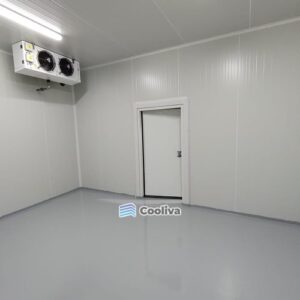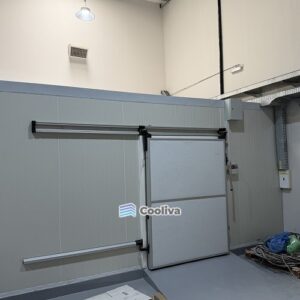
Your business needs a blast freezer when you regularly freeze fresh or cooked food yourself instead of buying it frozen. A blast freezer drives air at typically -30 to -40 °C across the product and freezes it to the core far faster than a storage room can. A storage freezer does a different job: it holds food that is already frozen.
Storage freezer vs blast freezer
Standard freezer rooms are storage rooms. The table shows how a blast freezer differs.
| Feature | Storage freezer | Blast freezer |
|---|---|---|
| Purpose | Holds frozen product at a steady temperature | Freezes fresh, chilled or cooked product fast |
| Air temperature | Typically -18 °C or colder | Typically -30 to -40 °C |
| Airflow | Gentle circulation around the stock | High-speed air forced through trays and trolleys |
| Product going in | Already frozen | Fresh, chilled or freshly cooked |
| Capacity stated in | Pallets or cubic metres | Kilograms per cycle |
| Panel thickness | 120 to 150 mm | 150 to 200 mm |
| Typical users | Restaurants, supermarkets, distributors | Central kitchens, bakeries, processors, food factories |
Why slow freezing damages food
Food is mostly water. As it freezes, the water forms ice crystals. Slow freezing gives the crystals time to grow. Large crystals puncture the cell walls. When you thaw the product, liquid runs out and takes weight, flavour and texture with it. You see it as a pool of liquid under thawed meat or chicken. Fast freezing forms many small crystals that leave the structure intact. Most of the water in food turns to ice between roughly -1 °C and -5 °C. The faster the core passes through this zone, the better the product comes out after thawing.
Why warm product does not belong in a storage freezer
Designers size a storage freezer for the heat that enters through panels and door openings plus a small product load. It has no reserve for a trolley of warm food. Loading warm product causes four problems:
- The new product freezes slowly and forms large ice crystals.
- The freezer temperature rises for hours. Frozen stock warms at the surface and refreezes, which lowers its quality.
- Moisture from the warm product settles as frost on the evaporator and forces extra defrosts.
- The core of cooked food stays too long between +5 °C and +60 °C, the range where bacteria multiply fastest.
The benchmarks: 90 minutes and 240 minutes
Caterers and equipment makers work with two benchmarks for cooked food. Blast chilling takes the core from +70 °C to +3 °C within 90 minutes. Blast freezing takes the core to -18 °C within about 240 minutes. Both assume shallow trays of portioned food. Thick cuts, whole birds and cartoned product take longer, so the designer calculates the cycle for your product. A core probe in the thickest piece shows when the cycle is complete. After that, chilled food moves to chiller rooms at 0 to +4 °C and frozen food to a storage freezer at -18 °C or colder. Confirm temperatures and times for your products with your supplier and the applicable SFDA requirements.
How suppliers state blast freezer capacity
Suppliers rate a blast freezer in kilograms per cycle. The figure means something only with three conditions attached: the product, its entering and final temperatures and the cycle time. Ask every supplier to state capacity this way. Four things change what the same room can freeze:
- Product thickness. It has the largest effect. Doubling the thickness more than doubles the freezing time.
- Packaging. Cartons, thick plastic and trapped air insulate the product. Unwrapped food on trays freezes faster than the same food in a closed carton.
- Trays and trolleys. Air must pass over every tray. Overfilled trays and trolleys pushed against the wall block it.
- Starting temperature. Product at +70 °C carries far more heat than product chilled to +3 °C first.
Who needs a blast freezer
- Central kitchens and caterers that cook in batches and chill or freeze portions for later service.
- Bakeries that freeze dough, part-baked bread and pastries to even out production.
- Meat, poultry and seafood processors that freeze portioned and packed product before storage or delivery. Our guide to cold rooms for meat, poultry and seafood covers the rooms around the freezer.
- Ice cream and dessert makers that harden product before storing it at -23 to -25 °C.
- Food factories that produce ready meals and frozen snacks. See cold rooms for food factories for the full storage chain.
Signs you need one
- You freeze fresh or cooked product in your storage freezer.
- The freezer temperature rises after every loading and the alarm goes off.
- Heavy frost covers the evaporator after production days.
- Thawed product loses liquid, weight or texture.
- Batches wait for freezer space, so freezing limits your daily output.
- Cooked food cools on racks at room temperature.
- A customer or inspector asks for core temperature records and you have none.
Design notes for blast freezer rooms in Saudi Arabia
A blast freezer is not a storage freezer with a lower setpoint. Its design differs in several ways:
- Panels: typically 150 to 200 mm, at the upper end in a hot climate, with an insulated floor and a heated pressure relief valve.
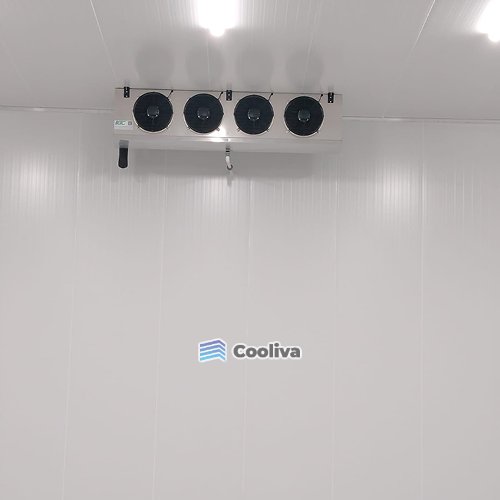
- Evaporators: large coils with powerful fans and wide fin spacing, so frost does not choke the airflow halfway through a cycle. Read how cold room evaporators work for the basics.
- Airflow: the room guides air through the trolleys, not around them.
- Defrost: electric or hot gas defrost runs between cycles, so each batch starts on a clean coil.
- Refrigeration: far more capacity than a storage freezer of the same size. Select the condensing unit for Saudi summer heat, commonly a design ambient of 46 to 50 °C, on a 60 Hz three-phase supply.
- Door and controls: a heated door frame, an inside safety release, a core probe and a record of every cycle.
- Layout: a storage freezer next to the blast room, so product moves a few steps after each cycle.
The build follows the same path as any cold room. See the stages of a cold room project for what you prepare on site.
Frequently asked questions about blast freezers
What is the difference between a blast chiller and a blast freezer?
A blast chiller cools cooked food to +3 °C for short chilled storage. A blast freezer takes product to -18 °C at the core for long frozen storage. Some operations need both.
Can I turn my existing freezer room into a blast freezer?
Not by lowering the setpoint. A blast freezer needs far more refrigeration capacity, larger evaporators with strong fans and usually thicker panels. A dedicated blast room beside the storage freezer is usually the practical answer.
How do I work out the capacity I need?
Start with the kilograms you produce on a peak day and the number of cycles you can run in a shift. Add the product type, its thickness, the packaging and the starting temperature. The designer turns these figures into kilograms per cycle and a refrigeration load.
Do I need a blast freezer room or a cabinet?
A reach-in cabinet holds a rack of trays and suits a single kitchen. A blast freezer room takes full trolleys or pallets and suits batch production. Choose by the kilograms you freeze per cycle.
Does blast freezing kill bacteria?
No. Freezing stops bacteria from multiplying but does not reliably kill them. Hygiene before freezing and correct thawing still matter.
Plan your blast freezer with Cooliva
Cooliva’s Riyadh team designs, supplies and installs blast freezers and blast chillers sized from your product, batch weight and cycle time. The blast room can connect to new or existing cold rooms and freezer rooms, so product moves in one direction from production to storage. Tell us what you produce per day and how you pack it. Send the details through the contact page or call +966 59 799 1000.