Cold rooms for meat, poultry and seafood must do three things: hold the right temperature for each product, keep product types apart and stand up to daily washing. Fresh meat and poultry are typically held at -1 to +2 °C, fresh fish around 0 °C and frozen product at -18 °C or colder. This guide covers the rooms you need, how to separate products and how to freeze and thaw without losing quality.
Why these products leave no margin
Raw meat, poultry and fish are moist, rich in protein and carry bacteria from the moment of slaughter or catch. Bacteria multiply fastest in the danger zone between +5 °C and +60 °C. Every hour in that range shortens shelf life and raises the risk for your customers. On an open dock in a Saudi summer, product gets there fast. Cold does not kill most bacteria. Chilling slows them and freezing stops their growth until the product thaws. So the cold room temperature, the time on the dock and the cleanliness of every surface all count.
Chilled or frozen: typical temperatures
Chilled storage suits product you sell or cook within days. Frozen storage suits stock you hold for weeks or months.
| Room or product | Typical temperature | Notes |
|---|---|---|
| Fresh meat | -1 to +2 °C | Hanging carcasses or boxed cuts |
| Fresh poultry | -1 to +2 °C | Kept apart from red meat |
| Fresh fish | Around 0 °C | Commonly held in ice with the meltwater drained |
| Frozen meat, poultry and seafood | -18 °C or colder | Product enters already frozen |
| Blast freezer | Air at -30 to -40 °C | Freezes fresh product fast |
| Cutting and processing room | +10 to +12 °C | Product stays for a short time only |
| Loading dock or anteroom | +2 to +8 °C | Protects the cold chain during loading |
Confirm these typical values with your supplier and the applicable SFDA requirements. For other foods, see the right cold room temperature for each product.
Separate rooms or strict separation
Raw poultry commonly carries bacteria such as Salmonella and Campylobacter. Fish has a strong odour that other foods absorb. Red meat drips. Put all three in one room without rules and each product contaminates the next.
When volume allows, give meat, poultry and fish their own chiller rooms or their own chambers inside one structure. A restaurant with small quantities often has one room. Then these rules apply:
- Raw product never shares a shelf with cooked or ready-to-eat food. Raw always sits below.
- Poultry goes on the lowest level, so its drip cannot fall on other products.
- Fish stays in lidded containers that drain.
- Each product type has its own trays, hooks and colour-coded containers.
- Nothing sits on the floor and nothing touches the walls.
- Everything is covered, labelled and dated.
Hanging rails or shelves?
Carcasses and large cuts hang from overhead rails. Air reaches every surface and the meat touches neither the floor nor the next carcass. Rails carry heavy loads, so they need their own steel support frame. Insulated ceiling panels are not built to carry hanging meat. Decide on rails before the room is designed, because they set the ceiling height, the door height and the route from truck to room.
Boxed and portioned product goes on shelves. Choose stainless steel, aluminium or food-grade plastic shelving that does not rust and lifts out for cleaning. Leave gaps between boxes and keep them below the evaporator air stream.
Drip, drainage and washable surfaces
Meat releases liquid, fish ice melts and you wash the room often. Plan for water from the first drawing:
- Floor: non-slip, sealed and sloped towards a drain, with rounded junctions between floor and walls that leave dirt no corner.
- Drains: trapped floor drains in chilled rooms. Freezer rooms usually have no floor drain inside, because standing water freezes.
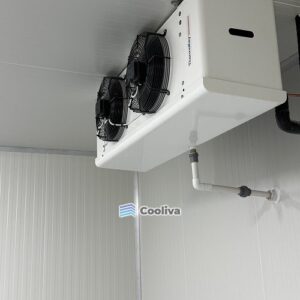
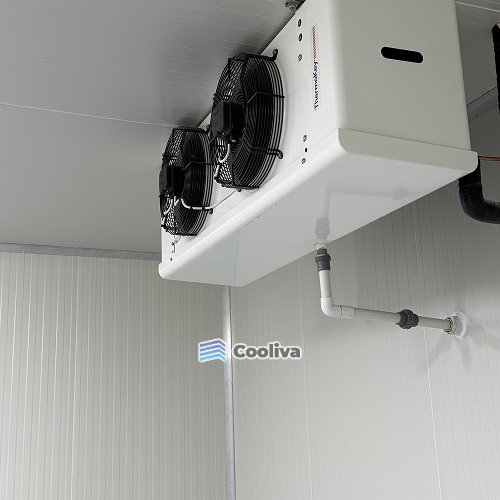
- Evaporator drain: a trapped line for defrost water. In freezers the drain line needs a heater.
- Walls and ceiling: smooth, washable panels with sealed joints. Stainless steel skins suit wet processing areas.
Panel and joint quality decide how the room survives daily washing: see cold room panels.
The processing room: +10 to +12 °C
Cutting, deboning, mincing and packing happen in a separate cooled room, commonly at +10 to +12 °C. Staff work there for hours, so it is warmer than storage. The product is a visitor: it leaves the chiller in small batches, gets processed and goes back or moves on to packing and freezing. Low-velocity air coolers keep staff out of a cold draught. Larger plants plan a one-way flow from receiving to dispatch, so raw and finished product never cross. Read more in cold rooms for food factories.
Freeze in a blast freezer, store in a freezer room
A storage freezer holds frozen product. It is not built to freeze fresh product fast. Load it with fresh meat and three things happen: the room temperature rises for hours, the frozen stock around the new load warms up and the new product freezes slowly. Slow freezing forms large ice crystals that damage the meat, so it loses more juice when it thaws.
A blast freezer does the job properly. It drives air at -30 to -40 °C across the product at high speed. A common benchmark is a core temperature of -18 °C within about 240 minutes. Once frozen, the product moves to freezer rooms at -18 °C or colder for storage.
Thaw under control
A frozen cut left on a counter warms from the outside in. The surface sits in the danger zone for hours while the core is still frozen. Thaw in a chiller at 0 to +4 °C instead:
- Plan ahead. Large cuts can need a day or more.
- Place the product on trays that catch the drip, below all cooked and ready-to-eat food.
- Use thawed product promptly and avoid refreezing it raw. Quality drops with each freeze and thaw cycle and the rules for your product may forbid it.
Records that protect you
A room that holds temperature today tells you nothing about last night. Fit each room with a display you can read from outside, a high temperature alarm and a data logger that records automatically. Add a door-open alarm on busy rooms. Measure the temperature of every delivery with a probe thermometer and write it down. Have thermometers and loggers calibrated once a year. Inspectors commonly ask for these records. They are also your proof in a dispute with a supplier. Our guide to cold room temperature monitoring explains the options.
Meat, poultry and seafood storage: common questions
Can meat, chicken and fish share one cold room?
Only with strict separation: covered containers, separate shelves, poultry at the lowest level and fish in lidded boxes that drain. Once volumes grow, separate rooms or chambers are safer and stop odour transfer.
Do I need stainless steel panels in a meat cold room?
Not in every room. Storage rooms commonly use food-grade coated steel panels. Stainless steel suits wet processing rooms, fish rooms and areas you wash with strong cleaning chemicals.
What causes freezer burn on frozen meat?
Freezer burn is surface drying. Ice leaves the product and settles as frost when the temperature swings or the packaging is open. Keep product tightly wrapped, hold the room steady at -18 °C or colder and limit door openings.
How do I stop fish odour from spreading?
In a shared room, keep fish in lidded containers, lead the meltwater to the drain and wash containers and floor daily. Odour travels with the air, so a separate chamber with its own evaporator is the only complete fix.
Cooliva for meat, poultry and seafood projects
Cooliva is based in Riyadh and builds cold rooms and freezer rooms for meat, poultry and seafood suppliers, restaurants, central kitchens, supermarkets and food distributors. The work begins with your products, daily quantities and workflow. The team then plans chilled storage, frozen storage, blast freezing and processing areas as one flow. Send your requirements through the contact page or call +966 59 799 1000.